telefantasy

You are currently browsing articles tagged telefantasy.

After raving about it on first viewing, I now find myself loving and hating ’Planet of the Dead’ in equal measure…
 

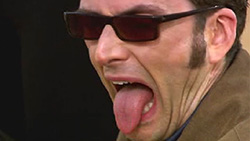
Tongue40 things I hated…

  1. If the Cup of Athelstan has been in the International Gallery for 200 years, why the sudden need to surround it with a security grid (open at the top and a two-foot gap at the bottom, of course)? Or do the armed guards go through their little ritual every night? If it’s been brought out for display, I’d whack it in a vault at night. Little tip. (Incidentally, I’m glad we never got to see this disaster of design and punctuation.)
  2. Might’ve been an idea to have oiled the waving cat, you silly bint.
  3. Why the ricocheting gunshot sound effect when the camera flips? Followed by a quite deathly twenty seconds of Christina looking hither and thither from one police car to the next. Over and over.
  4. Stock working-class bus driver. Irritating in so few lines, with an over the top accent that’s just weird.
  5. incompetentD I McMillan: awful awful awful, like a bumbling comedy policeman from an episode of Terry and June. Or CBeebies. “It’s definitely her, come on! Jackson, follow that bus!” Perfectly reasonable lines, but from the mouth of Adam James somehow… shit. And later he says “You do not have to say anything, et cetera et cetera” which proves he’s a rubbish copper too.
  6. How the hell does the stock bus driver remain so utterly oblivious to the entire ridiculously protracted, slow-moving pursuit?
  7. “The voices! So many voices!” God but Carmen’s dialogue is dreadful, especially coupled with constipated wide-eyed delivery. “Sometin is comin! Ridin on the wind!”
  8. Sorry to harp on about the working class characters, but Russell’s ‘ordinary people’ all sound and behave exactly the same. All have the same stilted dialogue and limited intelligence, none of them are allowed any fun, any witty lines, are patronisingly referred to as heroes just because they do their own everyday thing and have chops and gravy for tea, while the lords and ladies are larking it up elsewhere. When the Doctor says they’re ‘special’, is he being rude?
  9. “My boss is gonna murder me!” Die soon. Oh, he does, good. “He was a skeleton, man! He was bones, just bones!” Another thing about RTD’s ‘ordinary’ characters, they never use five words when ten sound stupider.
  10. Christina’s particularly punchable in the ‘team identification’ scene. Especially when she says “I am.” See also “I’m not letting you out of my sight” and numerous other occasions.
  11. Fook!“Angela. Angela Whitaker.” Is there a section in Spotlight containing Victoria Alcocks, Jacqueline Kings, Lesley Sharps, Camille Coduris, Helen Griffins, etc etc? Dour women of a certain age and a certain look, capable of a certain expression, with overweight husbands called Mike.
  12. “Low level psychic ability. Exacerbated by an alien sun.” Exacerbated? That’s a bad thing, right? By an alien sun? What the… heck?
  13. “I’m gonna get you home.” He’s a hero, that Doctor, let’s hammer it home in every single episode and applaud him heartily at the end.
  14. Remember when UNIT used to be fun? Can’t we have a Benton or a Yates, please? And less shoutiness.
  15. Gosh, you're gorgeousAnd Captain Magambo, words cannot express the violent feelings I experience every time I see your face or hear your strangely monotone voice. And I don’t like your shoes.
  16. “Ding ding!” blurts mentally suspect Angela Whitaker. And then what’s with the wasp-chewing face? (Pictured above.)
  17. Oh look, a mobile phone. Why can’t they be truly cut off? Or at least the Doctor could have jury-rigged the bus radio for very limited communication with Malcolm – surely that would have been more dramatic?
  18. “Listen, this is the Doctor. It’s me.” <Dial tone>
  19. “We all want to meet him one day but we all know what that day will bring.” Give me strength.
  20. Notice how the incidental music changes from dramatic to comedic the split-second the Doctor asks Malcolm what a ‘malcolm’ is? I’m not a big fan of continuous background music at the best of times, but do we need help knowing when we should be scared, when we should be laughing, etc? Curse you Hollywood!
  21. Stop speaking Tritovore, David, you look and sound like a complete fucking idiot.
  22. From the gorgeous exterior shot of the Tritovore spaceship go cut to some hideous grey, cheaply-redressed Cardiff basement.
  23. They discuss why RTD asks for creatures that look exactly like flies, rhinos, giant wasps etc on the Confidential, but doesn’t this narrow thinking lumber 21st century Doctor Who with a fraction of the imagination of the old series? Does the design department sleep at night?
  24. hairHow irritating and out-of-character does Christina get when she realises she’s got “dead people” in her hair? Argh!
  25. “Oh, you are clever!” After saying how great Lee Evans’ timing was on the “He’s gone” line, we now endure a painful wait before he adds a clunking “It is bad news!”
  26. “The worse it gets, the more I love it” is the single worst line in the whole thing. It sums up everything I dislike about the Cheshire Cat, cavalier nature of the last two Doctors. Tennant utters this line on learning that the manta rays are comin’ to eat the Earth, which is OK because he knows he can save the day by closing the wormhole. But he’s also recently learnt that the bus is out of diesel and he has absolutely no idea how he’s going to get everyone home. This annoying overconfidence diminishes the danger of the situation, especially because the Doctor’s never been proven wrong. “The more I love it!” What a prick. And Christina agrees, so she is too.
  27. “No water. All of it… dust!” Did you mean to write that, Russell?
  28. “In a super-clever, outer-space-y way.” Nice gag, the first time round, sounds dumb here though. See also: The Big Red Button.
  29. The gravity well looks like a… well. Of course. That’s yer actual science, you know.
  30. Tritovore earphone technology – need I say more?
  31. “Let me know.” “Nothing yet.” “Anything now?” “‘Fraid not.” “Any sign of movement?” “Nope.” “How’s that?” “Nothing.” “Any result?” “Not a dicky-bird.” “Any other way we can paraphrase this?” “Nada.”
  32. The stupid smile of Christina’s face as she zips down the shaft. Remember when Angelia Jolie’s Lara Croft is seen grinning like a loon seconds after learning the disturbing truth about the death of her father? Nobody likes a smart-arse, especially an emotionally-deranged one. So much grating, cocky dialogue in this scene.
  33. Would it have been so hard to get the CG bus to look at least the same colour as the real one? After all it’s been through the bus is finally knackered by some pillock on a Mac.
  34. Lee Evans’ slapstick with the office chair and fire extinguisher. “Not now!” Quite right.
  35. “I-don’t-believe-it-guns-that-work!” Did Noma Dumezweni go to the Andie McDowell School of Acting?
  36. The bit where the Doctor swipes the manta ray with the back end of the bus. Rubbish.
  37. Oh no, don’t kiss him!!! Oh, she did, she kissed him.
  38. It’s around this point that the orchestra becomes a Big Band and start playing the score for something else entirely. I don’t know what, only that it’s really horrible. This continues for the next ten minutes. Everyone loves it so much they break into spontaneous applause.
  39. To think, I wanted to see more of Lady Christina’s adventures. I hope to God we never see her maniacal toothy grin again.
  40. “Water always wins” sounds ridiculous out of context. But I’m hoping I won’t have to resort to cheap lists after I see ‘The Waters of Mars’…

pros40 things I loved…

  1. Michelle Ryan in a catsuit. Hate to state the obvious. Although, as the episode progresses, Ryan comes across as barely legal (despite being 22) and erotic feelings quickly evaporate.
  2. The camera flip’s cheesy but fun.
  3. The Doctor’s iconic shoes. That’s all you need.
  4. “It’s full of sugar and I’m determined to keep these teeth.”
  5. The little dish. I love a little dish. Much excitation.
  6. The sequence inside the bus as it passes through the wormhole.
  7. Nice pull back shot from the Doctor’s eyes and some cool music – a hint that we might be in for some more of spookily different incidentals that accompanied the trailer (we’re not).
  8. We’re in Dubai! Gorgeous panoramas (although the location’s still curiously underused).
  9. bonkersLou. I like you, Lou, shame your missus is bonkers.
  10. Three suns. Pretty.
  11. “Ready for every emergency.” “Me too!”
  12. Excellent tongue acting from the man Tennant.
  13. Nice wormhole! (Another Indiana Jones moment in an episode full of them.)
  14. The bus driver shuffles weirdly through the wormhole and dies spectacularly – hurrah! Much better acting from the skeleton.
  15. Like the talk of Faraday cages. Although, as pointed out elsewhere on this very site, why not just get UNIT to drive a tank through the wormhole?
  16. And the ‘appointment of a leader’ bit is amusing, however smug the leader may be.
  17. “Poor old Tina.”
  18. The Doctor’s quizzical/impressed/hubba-hubba expression when Christina hands over the spade and axe.
  19. Pizza Geronimo.
  20. Loved the recurrence of the salute gag.
  21. Really liked Lee Evans, despite the comedy accent, the Lee Evans tics and general Lee Evans-isms. Also this is the one time where the Doctor’s legendary status actually feels right.
  22. “What was your favourite? [Doctor Who and] The Giant Robot?”
  23. Quatermass! There’s Nigel, in his grave. “The spinnin’! So much spinnin’!”
  24. Lovely comic timing when the Doctor puts the phone down and Malcolm continues, “You’re mine– he’s gone. He’s gone.”
  25. Nice weird, wobbly B-movie zoom when we first see a Tritovore. And the fly heads are good, especially the yukky mouth parts.
  26. The Tritovore’s crashed spaceship is beautiful. Why we only get two glimpses of it I don’t know.
  27. Love Tennant’s nerdy guffaw after “the Honourable Lady Christina – at least I hope she’s honourable!”
  28. The Scorpion Nebula is ever-so pretty, as is the brief looping shot of Sanhelios City (sanhelios, incidentally, is a herbal supplement).
  29. “You look human.” “You look Time Lord.” Nice.
  30. Those manta-ray/shark things really are cool-looking, though they must whizz round at quite a lick to rip a hole in time and space, surely?
  31. Looky here!There’s a very nice shot of Christina’s bottom. Thank you Russell, for this concession to your heterosexual viewers.
  32. Hurrah, a reference to the Doctor stealing the TARDIS for us geeks! Is this the first time this has been mentioned in Nu-Who?
  33. Despite the engine looking oddly like a church crypt and the Doctor’s utterly random and inappropriate ”It’s gonna eat its way up!”, there’s much to love in the manta-ray ‘gravity well’ scene.
  34. The stuff about Barclay’s fake gold watch and the Doctor’s subsequent abuse of the Cup of Athelstan is a bit of a giggle.
  35. “I will never surrender. Never!” Good old Malcolm, defiant and heroic. Hard to imagine that a few seconds in the future, after the bus is safe, we’ll all be shouting for him to “just close the fucking wormhole!”
  36. Satisfyingly noisy battle between UNIT and the stingrays. With rain. Cool.
  37. “I love you! I love you! I love you!” Then watch Evans miming to the soldiers.
  38. Very considerate of the Doctor, recommending Nathan and Barclay to UNIT, and, as already established, sending them to their almost certain deaths.
  39. Good on the Doctor for refusing Christina, although perhaps better reasons might be she’s a jewel thief and really, really annoying. And how exactly has he “lost them all”? He keeps saying that, yet the last time we saw them the majority are quite happily living their lives. Even Donna.
  40. Carmen must be hellish to live with. Still, liked her warning to the Doctor, hope the cryptic message (“Knock four times”) isn’t as blindingly obvious as the fanboys think. ‘The Waters of Mars’ looks promising.

Tags: , , ,

Circus 1 now online

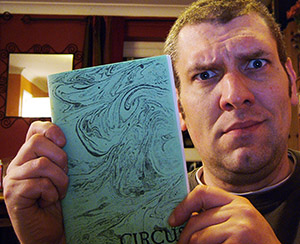
circus1You know those beastly fellows at The Ninth Circle of Hell and their repository of old Doctor Who fanzines? Well, they’ve taken it upon themselves to upload the first issue of Circus, my old fanzine, just so you modern kids, with your fancy iPoops and your indoor toilets, can cruelly mock its simple innocence and poke it with sticks. Have a look, it’s got words in it and everything, contributed by John Connors, Paul Farnsworth, Daniel O’Mahony, Keith Topping and more, but I beg you to be gentle.

Circus 1 (published December 1993)  is available here. More will follow. Curse you, Ninth Circle of Hell!

Tags: , , , , , ,

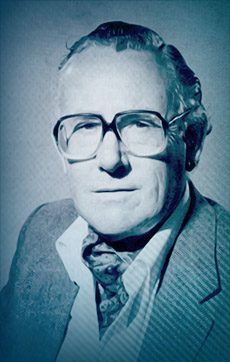
Christopher Samuel YoudWith the release of the BBC Tripods series on DVD and the promise of an Alex Proyas film adaptation, I thought this interview with the trilogy’s prolific author, conducted in 1999, might be of interest. I’d never interviewed anyone before, and found Sam incredibly generous and a true gent.
 

Were you a fan of science fiction from an early age?

I started to find SF fascinating in the occasional story in more general boys’ magazines, then discovered the (I think) September ’32 issue of Astounding and was totally hooked. Before that though I had been very fond of Coral Island and Swiss Family Robinson, both of which have characters with whom a boy can identify in – this is the important bit – exotic but at the same time possible settings. As I’ve often said, 30s SF offered extrapolation from current scientific thinking – not entirely and certainly not reliably, but one could fool oneself one might eventually find life on the planets in the way the Swiss Robinsons found that amazing (and quite impossible) variety of plants and wild life on that tiny Pacific island. I tell myself I turned away from SF when later scientific knowledge showed the solar system to be a barren emptiness and extra-planetary travel just wasn’t feasible. But I feel it was also like being through an intense love affair: the passion can’t be resurrected.

When did you decide you wanted to be a writer?

I started developing ambition in that direction at around ten, when I started an (of course) SF story which I never finished.

Who were your earliest influences?

Well, I did get round to reading better writers like Wells, but it was US magazine fiction which influenced me most – I detect echoes in, for instance, The City of Gold and Lead.

I was interested to discover that the writer of fiction you most admire is Jane Austen. Your books have always illuminated character – the human condition, as it were – as Austen’s do. Does this interest you more than scientific extrapolation?

I very strongly feel that the important and useful exercises of imagination are related to ‘the human condition’ – that Jane Austen’s imagination is stretched at a far higher level than, for instance, Arthur Clarke’s (sorry, Arthur). To me in my late years it seems self-evident that relationships are the root of existence, scientific extrapolation a pleasant toy.

And you were a fanzine editor?

John Burke’s publication of The Satellite influenced me to try my hand with The Fantast: hard sweat on a flat-bed duplicator with all that bloody stencilling … and a wild attempt to make it look professional by creating a justified right-hand image. The way I worked this out was by typing two drafts. On the first I finished several characters short of the right-hand margin and filled the gap with exxes; on the second I interpolated the exxes required as extra spaces between words. Nowadays you press a key. Old men, alas, remember. After I handed over Fantast to the more organized hands of Douglas Webster (and what became of him?), I fooled about with those other transitory efforts, before and (I think) during Army service. Popular? I think I had a mailing list of ca. 80 (or was it 60? – time magnifies) which wasn’t bad, when you remember I charged 3d (1.25p) per copy, and the mailing cost was 1.5d. Popular within the narrow circle of 30s UK fandom? Maybe. We were not so popular with the London establishment – Ted Carnell, Frank Arnold etc.

What did you do during the war?

I was Royal Signals, a Signalman throughout. We were a field intercept unit, in Gibraltar, then North Africa and eventually Italy. At the war’s end we were stationed at Predappio, in the castle Mussolini had built overlooking his humble birth-place – or rather, officers were in the castle, we were in tents in the (dry) moat. I nicked asparagus from his kitchen garden and had my 23rd birthday there: we got roaring drunk in the nearest town where we picked up a Polish Sgt-Major, who took us to his unit for disgusting rissoles and came back with us for more booze. He had sons fighting on both sides, and was keen on carrying the failing war on to Moscow: we, after over three years overseas, were less keen. It was there we found the Germans suddenly going from code into plain language, and I took down a message from Kesselring to the troops, starting: ‘Der Fuehrer hat ein Heldentod gefunden …..’ ['The Fuehrer has found a hero's death...'] A few days earlier they’d hanged our absentee landlord from a lamp-post in Milan, but this meant it really was all over.

You sold your first SF short story in 1949, and in the same year The Winter Swan was published. How did this first break come about?

Having fallen out of love with SF, I had an ambition to write general fiction and was encouraged by getting an Atlantic Award from the Rockefeller Foundation when I was demobbed. So Swan. But I was married and broke, hence stories aimed at the US magazine market.

Isn’t there a strong suggestion of reincarnation in The Winter Swan?

Swan wasn’t about reincarnation, in which I have never been able to believe (my eldest daughter, a Buddhist nun, has different views). If anything, it related to an outdated suggestion by Ouspensky (I think) that we are four- dimensional creatures, the fourth being (of course) time – and that at the end of our lives we lumber away into infinity burdened with every moment of our earthly existence. My chief character was interacting with other such entities, as part of a learning process.

Until you were able to write full-time in 1958, what other jobs had you done?

After my two years with an Atlantic Award, I got myself a job with the Diamond Corporation, as assistant to the Director of their Industrial Diamond Information Bureau. I knew nothing then about diamonds, and not much more when I left them, nine years later. But I could write and edit reasonably in English, a necessary skill in an office run and staffec by central European refugees. When my boss had his first stroke I carried on, and when a year later he had his second Head Office (in Johannesburg, 8000 miles south) didn’t know what to do. The London office, in desperation, asked if I would stand in on interviews for his successor; and subsequently recommend. I did, and three days later they asked if I woud take on the job. I agreed, for a quite pleasant year, and then sold Grass to MGM. In many ways I was sorry to leave.

Did you write under so many pen-names to avoid being pigeon-holed as a science-fiction writer?

Well, no, I didn’t want that pigeon-holing: John Wyndham and I both took exception to it. But also I knew of no publisher who would take my output (four books a year in my spare time from the office for 2/3 years) under one name. And the Trades Description Act featured too. I could well imagine the disappointment, nay disgust, with which someone who’d liked Malleson at Melbourne found himself reading Felix Walking or Dust and the Curious Boy. Labels are useful.

As well as science fiction, and the more realistic novels published under your own name, you’ve written light comedies, several thrillers, historical romances and gothic horror – which genre did you find the most rewarding?

They were all rewarding in their own way. The only one I now recall as a bit of a chore was the only one in which I picked up an idea offered by someone else, in this case an old Army buddy – about a German spy coming in from the war-time cold and deciding he’d prefer to opt out of service and stay in the UK. That was the Peter Nichols thriller. On that pen-name, it was meant to be Peter Nicholas (Nicholas being my first-born) but the UK publisher wanted Nichols. The real Peter Nichols was unknown at the time, but I’d like to apologize retrospectively.

I was interested to read that, prior to the Tripods trilogy, you wrote all your books in a single draft. Are there any novels you now wish you could have spent more time on?

What I did was type the first chapter without carbons, then put in three carbons for subsequent chapters, and at the end re-type that first chapter with three carbons (two copies for possible publishers, one for the UK agent, one for file). In those days I reckoned that, ref Ben Jonson’s observation on WS, I didn’t need to blot a line. Since some of my more successful books were done this way, I can’t say I had great regrets about my slipshod method. I’m sure a lot of slack writing got through. I was given the chance of revising the Tripods books when Puffin took them over, prior to the BBC TV series, and accepted it gladly. Book 1 had been rewritten twice, at publisher’s behest, Book 2 once. Book 3 was taken as sent by both UK and US publishers. That was where I found extensive revision more necessary. I’ve twice suggested to the US publisher that, after 30+ years, they might reprint with revisions, but they have refused. So all one can say is that the Penguin UK version is the authorized one.

How long would it take you to write a book?

It varied. Fastest was The Burning Bird – less then four weeks for an adult novel. I used to work on a basis of ten pages, 2500 words a day, on a five-day week, so first drafts of children’s books (ca 45,000 words) were about four weeks. I used to play snooker in late afternoon and would not go to the club until I’d done my stint – not unsurprisingly I found my rate quickened in the afternoon.

What advice would you give to aspiring writers who are just setting out?

I don’t think there is any practical advice: you just have to keep at it. Swan was sold to the first publisher who read it – as I later realized, a fluke. My second novel went the rounds for over two years before being taken by the firm that had already taken my third. When children ask me this, I offer two suggestions: to read as widely as possible (not just what takes your fancy) and to practice continuously, through a diary if nothing more constructive comes to mind. What you need most of all is stamina. Apart from luck, that is.

Although you did the complete opposite in The Winter Swan, would you recommend the old advice of ‘writing about what you know’ to a new writer?

Probably yes. Having said that, an early Christopher, The Caves of Night, picked up one review which said (roughly) John Christopher may not be much of a writer but he certainly knows his caves. I’d read up speleology intensively, and never been in any caves apart from Cheddar. Acknowledgements to the Lambeth Public Library. And a Guernsey resident commented (re World in Winter) that she was amazed how well I’d portrayed Lagos. I’ve never been to South Africa either.

I’d like to ask you some questions about the ‘catastrophe’ novels you are perhaps most famous for. It has been said you’ve killed more people (in your work!) that any other writer: the human race has met its doom by radiation sickness (‘Begin Again’), sterility (‘The New Wine’), starvation and hydrogen bombs (The Death of Grass), freezing to death (The World in Winter), earthquakes and volcanos (A Wrinkle in the Skin and the Prince in Waiting Trilogy), alien invasion (The Tripods Trilogy), plague (Empty World), madness and starvation again (A Dusk of Demons) … What draws you back to this theme time and again?

I don’t know the answer. A blinkered mind may have something to do with it. I’ve tended to follow von Clausewitz’ advice not to reinforce failure, and maybe consequently over-reinforced (moderate) success. And I’ve tended generally to go in for situations where a few characters react under stress: those are all very stressful scenarios.

Those novels are often mentioned in the same breath as those of John Wyndham. Do you admire his work, and how do you think your approaches to similar themes differed?

Nice to be mentioned in the same breath. I did indeed admire his work. Someone recently (very generously) classed me among the five major British SF writers of the century – there was a special glow in that John and Olaf Stapledon were two of the others. As to approaches to similar themes, some other one described John’s as ‘cosy’ catastrophes. Not true, but his characters are pleasanter, and he plainly likes them more. But he himself was one of the nicest and most amiable of men. The only sour note I recall is in that short story, ‘Survival’, where a horror of the female seems unexpectedly to emerge. He was educated at that (then) advanced public school, Bedales, which was a pioneer in co-educational boarding, and which one would expect to help its pupils overcome the normal (English – male) inadequacies. In fact he was terribly shy with women, and didn’t marry until he was over sixty. He then retired to Petersfield, within walking distance of the school. Life is strange at times.

What was the inspiration behind The Death of Grass?

It’s unusual to be able to recall what started a book off, but in the case of Death of Grass it happens that I do. I’d read a book by Ward Moore, Greener Than You Think, about a grass which took over the world, growing everywhere unstoppably. I seem to recall a final scene in which the characters take to the ocean, only to find grass growing up through the deck planks. I wondered about the reverse; and then thought about what ‘grass’ involved – e.g. the wheats and such.

A Wrinkle in the Skin is, I think, my favourite of all your novels. The imagery is so striking, particularly the drained seabed littered with dead fish and stranded ships, and the characterisation of Matthew Cotter is particularly strong. What gave you the idea behind this novel?

I think it is probably my favourite of my adult novels. As to idea behind, I was living in Guernsey at the time and notions of  separation from the mainland would be strong. But I think impetus also derived (as so often) from 30s SF: anyone else remember Jetta of the Lowlands? I had a big American fan for that book, and women generally seem to like it more than my other stuff. This one was a screenplay writer in LA. I gave her a free option for years, and in return she sent me Gourmet Magazine. She later joined the newly launched Playgirl and offered me copies (in a brown paper wrapping). I didn’t respond, but she eventually sent me one, with the male genitals hidden by pasted- on fig leaves of different sizes (depending on the picture magnification). My youngest daughter then eight got hold of it from my desk, and tore the fig-leaves off. The American lady never sold the screenplay.

Like so many of your lead characters, Cotter could not be classed as a ‘hero’ – he’s rather ineffectual, spending most of the book searching for his daughter and refusing to see the larger picture. It’s a running theme of your catastrophe novels, how different types of people adapt to the challenging new world they’re thrust into – shades of Ballantyne and Wyss again?

You’re probably right about Cotter; maybe that’s why women like him better. As to my other main characters being wimps, I’ve never thought about it. Autobiographical? But I do think Ballantyne and Wyss go quite deep with me. And then 30s SF.

I don’t think they can be classed as wimps as such, but most of them have major flaws. For example, it’s Luke Perry’s wounded pride at being rejected by Blodwen that causes so much bloodshed in The Sword of the Spirits.

Big difference between wimps and flawed characters. I don’t see Luke as a wimp, but his pride certainly damages him, and everyone else. And there’s the question of honour. This is not taken as seriously as when I was young (for instance, Hugh Dalton resigning as Chancellor after he inadvertently allowed a reporter to scoop his Budget speech) but in Luke’s world it matters.

Your writing suddenly changed direction in 1967 when you began writing almost exclusively for children. How did this come about?

My agent, David Higham, passed on a suggestion from Richard Hough, at Hamish Hamilton Children’s Books, that I be commissioned to write for them. I’ve never accepted commissioning, but I thought I might have a try. (Around that time Avram Davidson mentioned he’d been told that children’s books were a good bet, in that (if you found a publisher who’d keep them in print) you could pick up a new audience (in the 11-14 age bracket) every three years. Years later he wondered plaintively why he hadn’t taken his own advice.) I wrote The White Mountains, and Dick Hough accepted it, though interestingly on somewhat inferior terms to those proposed originally. It went to my US agent, who sent it to Macmillan. Susan Hirschman, their editor, wrote a long letter which he sent on: she said it started great and then fell apart. I thought of telling her to get stuffed, then looked at the book again, and realized I’d been thinking ‘Well, it’s just a children’s book.’ So I rewrote after Chapter 1. She said the middle was still wrong, and I re-wrote again, Dick Hough accepted all three versions as they came along. That was when I began to realize that, in the right hands, editing in children’s books was much more serious than in general fiction (by that time I suppose I’d had close on twenty adult novels published). On City of Gold and Lead, she just required a re-write of the opening. On Pool of Fire, she cabled ‘Great!’ to the first draft. I thought I had it licked. I went into The Lotus Caves with confidence … and she told me it was a mess. I said OK, write it off. She wouldn’t have that. By now a great pal of Julia MacRae, who’d replaced Dick Hough, she flew to London, had me flown over from Guernsey, and sat us all three down in Julia’s Bayswater flat with the grim message that no-one would move until we got a solution. Julia put in the breakthrough, hence my dedications of the UK and US editions to Susan ‘For flying to the rescue’, and to Julia ‘for the spark that broke the log-jam’. Incidentally, at the point when I was abandoning that book I did my bit of going to Herm for the day to relax/work things out, and it occurred to me an old idea, meant as an adult book, might work in the younger genre. That was The Guardians.

How does writing for a younger audience compare to writing for adults?

As I’ve suggested, more disciplined. Other than that, I don’t think I do anything different except leave out sexual entanglements.

Did The White Mountains begin life as an adult novel? Indeed, was it conceived as the opening book of a trilogy?

No, The White Mountains was conceived all along as a children’s book. The Guardians was thought of as an adult novel but never written. The Prince in Waiting was actually written as an adult novel (and I think the typescript is about somewhere), as the option novel for Michael Joseph after The Year of the Comet. Clemence Dane, MJ’s editor, didn’t like it. I put it aside and wrote The Death of Grass, which she did like. As to being planned as a trilogy, well no. I think I knew there had to be a sequel, but when I finished it had not myself worked out what the Tripods were.

Were the Tripods inspired by H G Wells’ Martians?

It may be hard to believe this, but I’d forgotten Wells’ Tripods until after the book was taken. I then set out consciously to adopt a more logical approach. Wells’ Tripods had been used by ‘spider-like creatures’. I wondered (then – and like anyone who’s tried to make them work on film) how they actually progressed … and for that matter, why. If Wells’ Martians had been copying a body-image they would have used eight-legged crawlers (which would have also been more efficient). From the Tripods I developed the Masters and their triangulated city. I also thought of the stilt-men of the French marshes, and gave them a marshy steamy planet as their point of origin.

There’s a great sense of geography in the trilogy, and the level of detail suggests you know the areas the characters travel through very well. Is this the case?

No. I used (large-scale) maps. Wherton is near Winchester, but not a particular place. Rhymney is New Romney, though I’d at that point never been there. But I had been to Switzerland, and had been up that extraordinary railway to the Jungfraujoch.

Was the ‘Chateau de la Tour Rouge’ in The White Mountains a disguised Fontainebleau?

Again, no, just an idealized chateau (and I’m not a chateau-man). Richard Bates, who produced the BBC TV series, used Alan Clark’s castle at Saltwood, superimposing a French chateau roof-line (Clark mentioned this in his Diaries, scathingly but appreciative of the money). We went there for some of the shooting, and I remember Jane Clark telling us about their idiotic peacocks, which roosted high in the trees and got blown away every gale: ‘the air is full of gusting peacocks’. Don’t know if she mentioned that to Richard: I wouldn’t have been able to resist working it in.

Similarly, were the limestone caves in The Pool of Fire (and, indeed, The Caves of Night) based on the Hallstatt caves in Austria?

Again, alas no. I was stationed at Frohnberg at the end of the war, and there was a trip to the caves for which I booked. But the truck left without me, and I never got to see them.

The Swiss mountains, most spectacularly the Jungfrau in the Tripods trilogy, would seem to have made a great impression on you. When did you first visit the area?

I lived with my family in Switzerland for a year between 1958 and 1959, and in that time visited the Jungfraujoch, which certainly was impressive. I recall setting out around 5 a.m. to drive to Interlaken (where the railway starts), and arriving at the top some seven hours later, ravenously hungry. There was, of course, a restaurant at the top (these be Swiss mountains) and I raced for it. When my main course arrived I found among the cauliflour the largest boiled caterpillar you could imagine. I drew the waitress’ attention to this and she apologized. Later I saw her go to the serving hatch and observed her in convulsions of mirth with the kitchen staff. I suppose it was funny: carting a caterpillar up to 11,000+ feet to feed to an English tourist. But I’d lost my appetite.

Before I ask you about the TV adaption of The Tripods, can I ask if you had any say over the film adaption of The Death of Grass? Having seen it, I would guess not! Did you sell the rights to any of your other books?

You guess right. Before it came out my London agent told me Cornel Wilde had said this was going to be the Great Anti-Pollution Movie, and there would be a book-of-the-film to punch the message home. He was disabused of that. I’ve never seen it. Years later it was shown on TV, and I thought I might manage it from my own armchair, with a comforting glass of whisky on hand. I lasted to the first commercial break, then went to bed. More recently still, someone gave me a video. I haven’t watched it. Rights were sold for a quite modest sum for The Possessors, and for a long time after I averaged a new inquiry a year; but it never got made. Most inquiries come to nothing, of course. Bavaria did The Guardians as a 6 x 50 minute serial, in German but with bits like ‘Please’ which don’t work well with lip-synch in English (and with some English characters). This was when Richard Bates was making The Tripods. He scrupulously sent advance scripts and asked for comments and thanked me for them, but took no notice. The Germans did none of that but asked my wife and me to Munich during a late stage of production. I found, to my amazement, that unlike RB they had followed my story line rigorously. One lady said anxiously that they had had to make a change. At the point where the boy sees a squirrel cross the fence and realizes it cannot be electrified as he’d feared, they used a cat instead. ‘We are very short of trained squirrels in Germany, Mr Christopher’. Yes, I too think she was sending me up. That same company, which made the magnificent Das Boot, also did Empty World as a 90-minute teleplay. A schoolgirl wrote to say how shocked they had all been, that a book they had studied in school should be turned into a piece of ‘Kitsch- Horror’. Bavaria sent me a video of The Guardians, but wouldn’t send me one of Empty World.

Is there any news of Touchstone’s film version of the Tripods trilogy?

I’m not sure what’s currently happening on the movie front: I was told three months ago there was a script in and I’d be sent a copy, but nothing has happened since. I’m aware of a basic problem with the Tripods-as-Movie in that producers tend automatically to regard it as (futuristic) SF. From that standpoint nothing is lost and vast box-office advantage is to be gained by transferring the setting to North America. I’ve no idea whether Touchstone are looking at it from this viewpoint – Jerry Hellman, whose higher than usual sensitivity may be judged by his having produced Midnight Cowboy, had that notion, and actually took the trouble to come to Rye to convince me of its necessity. I wasn’t convinced, but knew better than to argue. Having failed to raise the necessary cash he later told me he was going back to the original setting. It still didn’t work – American financiers are extremely reluctant to put up money for SF films based outside America.

Yet the feedback I’ve had from (overwhelmingly American) children over more than three decades shows that what they most like about the books is the unnerving feeling of being in a historical set-up, incidentally lit by monstrous flashes from some mysterious future: predominantly it’s the mix of past and future which grabs them. And unfortunately the USA doesn’t have a past in the European sense. There’s no mediaeval background to relate to: transferring the Tripods across the Atlantic would be like setting Robin Hood in New England. (Americans are in fact entirely happy about foreign settings for historical movies, eg. Braveheart.) And unless it’s done as basically historical rather than as routine SF, my feeling is it won’t work.

I understand Richard Bates bought the rights to the Tripods books fifteen years before the TV series, just after you wrote them?

Not true. There were four options, over a period of something like ten years; Richard Bates as associated with the first of these and was solely concerned with the final one which actually resulted in production.

Did you ever have the option of adapting the books yourself, or is scriptwriting not an area that interests you?

I don’t think it was ever suggested as such. Richard did try to get me interested in writing for TV generally, and observed that he’d never encountered such negative selling of potential skills. I’ve always felt that it was a specialist technique which (unlike for instance writing in English-as-a-foreign-language) has not engaged my interest. I think probably I was put off anyway by the prospect of having to work in with someone – director, producer, co-writer, actor – eventually. I’ve always been a bit of a one-man band.

As I understood it, you and Richard Bates worked together to develop the storylines for the television series, but you’ve suggested in a previous answer that this was not the case. Were none of your suggestions taken up? Which of the changes to the books were you dissatisfied with?

No, there was no co-working, and I wouldn’t have been much good if it had been offered. (See above). Richard very courteously sent me scripts in advance and solicited comments. I don’t recall that he used any. Contrariwise, Bavaria who at roughly the same time did a German-language version of The Guardians, sought no help but, as I discovered when they asked Jessica and me to Munich during final filming, had scrupulously followed the story line. Richard (and Alick Rowe) followed the story line reasonably well for the first half dozen episodes, at which point Richard explained that they had run out of location time and would have to concentrate on studio work, and that he proposed introducing a few new characters. I’d already realized that the books were too boy-oriented for the then current climate, so wasn’t too surprised when a Scots woman married to a French vine-grower appeared, with daughters. I thought five of them was a bit OTT, though. So again I wasn’t surprised at the girls turning up in the second series, though I thought taking their names from Mozart operas was a little absurd.

Was the BBC’s visualisation of the human characters, the Tripods, the City and the Masters at all like you imagined them?

I didn’t have any serious objections to any of those. The boys may not have been  brilliant actors, but they were nice guys. I remember the lad who played Will complaining about having to learn to ride a horse, and swearing when it stood on his foot when they were shooting locally. It then distinguished itself further by defecating on camera.

Overall, what did you think of the two series, and why do you think they ultimately failed?

After the reasonably faithful book-replication at the beginning, I was probably bound to find the increasingly wide divergences irritating. My (I think reasonable) guess was that someone (Richard?) thought he could improve things by following a more orthodox science-fiction path – hence the Cognosc. Since I had grown out of orthodox SF many years before, I just thought it silly. The second series got so far off my path that I just couldn’t recognize it – all that circus stuff … And it wound up on that downbeat episode which (I was told) had been copied from one of the Star Wars films (I haven’t seen any of them) – with the aim of introducing a hook that made a third series inevitable. As you know, it didn’t work. I was told at the time that the first series had an audience of ca. 6.3 million, the second 5.1. There was certainly a decline in viewing figures, but whether other factors were involved I’ve no idea. The premature closing didn’t bother me, though naturally I missed the associated book sales. (The day of the first episode, Julia MacRae, who had edited the UK side, called me, and said:  ‘Never mind the television – with luck you’ll sell more books.’)

How did the prequel, When The Tripods Came, come about?

At some point during the first series, the Beeb did a discussion thing which included Brian Aldiss as a panel member. Brian started by saying he didn’t like ‘backwards-looking science-fiction’ anyway, and then went on to pour scorn on the notion of the Tripods being able to overcome late 20th century human technology. ‘They don’t even have infra-red’, he observed caustically, presumably referring to the use of searchlights in tracking the boys. (This is an interesting example of the built-in obsolescence characteristic of SF; when I wrote the books infra-red was laboratory stuff, and no one would have predicted that sixteen years later you would use it casually to switch channels on your TV. The first remotes – do you remember? – were in fact photo-optic). Anyway, I did recall that the improbability had concerned me even when I was writing The White Mountains, and that I had dropped in a casual reference to TV being used as the chief instrument of conquest. So I went back and developed that. Incidentally, in both cases there’s yet another harking-back to thirties US magazine SF – a story about someone achieving a hypnotic conquest of the world – through radio …

Is ‘The Trippy Show’ a criticism of television’s effect on children? Also, does its cartoonish nature perhaps refer to the BBC’s Tripods?

I suppose the whole book is a comment on television’s effect on people – not just children. There was no specific reference intended to the BBC’s Tripods. Actually ‘The Trippy Show’ as I suggested it was more complex than anything I’ve yet encountered, a mix of ‘cartoons, live action, stills and abstracts’ (as I’ve just gone back to check). The serious influence of TV cartoons on adults (The Simpsons, King of the Hill) was then unthought-of.

Apart from three Gothic romances, you’ve written exclusively for children for over thirty years. Did you have no urge to return to writing for an adult audience?

The young adult audience basically satisfied me. It was reasonably successful and provided much more feed-back than the adult had. There was the occasional unsuccessful divergence, e.g. a memoir, which the two or three publishers who saw it didn’t care for. (You need a name, or reputation, to justify a memoir in the increasingly harsh publishing scene). A few years ago I did have an idea for what seemed a worth-while return to adult fiction, and indeed wrote it. It went first to Hodder, under an option then a quarter of a century old. Nick Austin who handled their SF side at the time said he felt that qualified for the Guinness Book of Publishing Records. He also wanted to publish it, but his board over-ruled him. (‘There was only one other guy who knew who you were, Sam, and he was even junior to me.’) I tried it around subsequently, but no one else wanted it. It’s a tough world these days.

It’s been far too long (six years) since A Dusk of Demons. Do you have any plans for further novels or short stories?

No current plans. My wife has been in poor health recently, which makes it difficult to concentrate. So does old age.

As the fiftieth anniversary of your first published novel approaches, what do you think was the greatest achievement of your writing career, and which of your novels do you look back on with most fondness?

I think the greatest achievement was maintaining the stamina to go on, with a few minor successes and many more setbacks. Looking back with fondness, in adult fiction it’s probably A Wrinkle in the Skin, in young-adult the Sword trilogy – though there I also have a lingering fondness for Dom and Va. That was written first in EFL, Stage 2, re-written as a children’s book. In the first form it stayed in print in the UK and US for well over a score of years. In the latter, it was quickly destroyed by ardent feminists and never got into paperback. (Puffin paid me a contract cancellation fee higher than their [modest] advance, to get out of the deal). It continues in two areas in the US, where women teachers with my blessing photocopy it for use in schools.

Do you get much feedback from your readers?

Quite a lot from children, chiefly US children. It’s a big change from adult novels, where the one I best recall was a postcard saying (roughly): ‘On page whatsit you have a character bend down to sniff a Frau Karl Druschki rose. The Frau Karl Druschki has no scent.’

Who, or what, makes you laugh?

An awful lot of things make me laugh, including at the moment the spectacle of a Prime Minister helping hound out of his job a semi-literate England football coach who has insisted on expressing his belief in some semi-digested bits of Buddhist thought. (Perhaps I should add that I regard Buddhist thought as philosophically primitive compared with Christianity). I like word play, and journalistically enjoy such writers as P J O’Rourke and Mark Steyn. But I’ve never taken to P G Woodhouse: there I pick up the verbal ingenuity but can’t tune into the basic facetiousness. Back to Jane Austen: she makes me laugh.

Finally, are you optimistic about the new Millennium, and do you think expensive projects like the Dome are a worthy celebration?

I’m neither optimistic nor pessimistic about the Millennium, seeing it important only as a trigger for nut-case enthusiasms which are always latent. As far as the Dome is concerned, I’d say Bring Back the Skylon. (I didn’t like that, either, but I was half a century younger.)

Sam Youd, thank you very much.

Tags: , , , ,

<Disclaimer> I wrote this article, on writer Robert Holmes’ work in the 80s, way back in 1993 for the first issue of Circus. It’s a bit cocksure and probably riddled with factual errors, but it holds up reasonably well I think. </Disclaimer>
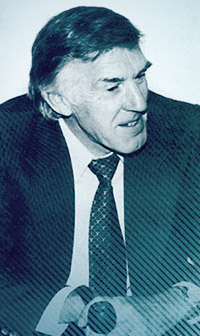
 

Bob plus trusty pipeDuring one of the economic ice ages that regularly grip our household I bought a Citroën 2CV. The salesman assured me that this machine was the last word in frugality with an engine that ran on gnat’s water. ‘Ran’, in this context, is probably the wrong word. It sort of ambled. But it was a fine car and gave one plenty of time to admire the scenery. There was also the excitement of burn-ups with passing tractors and invalid carriages.

I mention this only because it fills up some of my fifteen hundred words and also to make my point that I am the 2CV of scriptwriters.

Robert Holmes, ‘A Life of Hammer and Tongs’ (The Doctor Who File)

Robert Holmes’ last work for Doctor Who after Anthony Read took over from him as script-editor was ‘The Power of Kroll’, a story with which he was naturally unhappy. He had been asked to write a script that revolved around the largest monster in the programme’s history, a feat he found difficult, particularly when he disliked traditional lumbering monsters, relying instead on unusual, appealingly quirky characters. Although it isn’t in any writer’s nature to deliberately produce sub-standard work, Holmes’ last Who story for six years must have been a disappointment to him.
He was hardly idle in those six years. After turning down the post of its script-editor, Holmes wrote four excellent episodes for Blake’s 7, including ‘Gambit’, considered by many to be the series’ best story, certainly its most unusual. In 1980 he took over from Bob Baker as script-editor for season two of Shoestring, and in 1981 adapted David Wiltshire’s novel Child of the Vodyanoi into the acclaimed BBC1 serial The Nightmare Man.

Holmes had also outlined a series for LWT, as Jon Thurley (Holmes’ agent from 1967 onwards) describes: “[Bob] wrote a very funny and extremely black comedy which was piloted with Bob Hoskins and Jimmy Cossens playing two escaped convicts on the run, who, during the course of their picaresque adventures meet an apocalypic tramp who lights a cigarette and accidentally immolates himself, and a black prostitute who throws them off her pitch under Waterloo arches. It was reluctantly concluded that the series was probably too rich for the audience of the time, and LWT did not make the series!”

The Six Doctors

In 1982 Doctor Who‘s Twentieth Anniversary was looming, and John Nathan-Turner and Eric Saward planned to celebrate it in a style reminiscent of ‘The Three Doctors’ in 1973. Nathan-Turner had known Holmes socially for many years before producing Who, having both worked at Threshold/Union House in the early 70s. Nathan-Turner: “It was a wonderful place to work, with a constant cross-pollination of ideas, individuals and aspirations”.

Saward had been keen for Holmes to return, having seen enough old Who stories to realise that he was one of the programme’s finest living writers. Nathan-Turner was reluctant, according to a dubious [DWB 57] interview with Saward, because JNT was “frightened of him”. However, this time Nathan-Turner’s own explanation is more likely: “I did have, initially, a reticence to consider Bob as a writer; his involvement in Who had been of a specific direction, instigated in no small way by Bob himself, and I wanted to have time for our team to focus its objectives. ‘The Five Doctors’, in our view, required a writer steeped in the Who mythos – QED.”

‘The Five Doctors’ required, naturally, the involvement in some way of every Doctor, plus a wealth of returning monsters and companions, all to be fitted into a coherent and entertaining storyline, but more difficultly, ninety minutes. A near impossible task for even a most accomplished writer such as Holmes.

Eric Saward [DWB 57 again] : “I remember when Bob walked into the office. He came in a big man, tall, ex-policeman many years ago and he still had that presence. I think he looked at John and I and thought ‘Crikey, a couple of real jerks here’! He was wrong because he shouldn’t have made it so obvious, but he was right in that we were being silly about what we wanted. John wanted the Cybermen, the Master and the all the other bits and pieces that came into it, and Bob said: ‘Forget it, the Cybermen are stupid, they don’t work very well and I like creating original characters’ … Still we asked Bob to continue and we said we’d commission him to do it but he wasn’t certain he could make the story work … So Bob went off and wrote 14 or 15 pages of the script and I read them and to be honest they weren’t very good. I don’t know what had gone wrong, I mean, they were funny but it was ploddy and it was as if his heart was not really in it.”

Unfortunately, neither Saward nor Nathan-Turner now remember Holmes’ story Holmes rarely committed detailed storylines to paper although it is known he planned for Sutekh to return as the villain of the piece. Not surprisingly, Holmes quickly withdrew from the project, [Nathan-Turner:] “feeling we were giving him too many confines within which to work. It was totally amicable and I understood completely.” [Holmes' five pages of storyline suggestions for the story (working title 'The Six Doctors') has since been published in Doctor Who The Handbook - The Fifth Doctor (1995). I like the idea of a robot First Doctor, explaining why he looks different to how we remember, and Maladoom's a cool planet name! CB]

What none of these versions of events mention are the details of Terrance Dicks’ involvement, which goes some way to showing the somewhat irresponsible way many respected writers and directors were being handled during this period. Dicks: “Eric Saward phoned me at a Who convention in New Orleans and asked me if I’d like to write the Anniversary Special. Naturally, I accepted.

“On my return to England, Eric told me that Bob was already working on the special, but there were ‘problems’. Would I like to write my own Special in parallel with Bob so the production team could choose the best one? I felt this was no way to treat a writer of Bob’s status or come to that, of mine and rejected the invitation. Some time after that, Eric called again and told me that Bob had withdrawn from the project. Would I like to write the Anniversary Special … which, eventually, I did!”

Ideas

Robert Holmes’ television work was by now beginning to dry up. During the mid-80s he had plenty of ideas for television series, but none of them came to fruition. It had long been his desire to write a series on the life of the newspaper baron Alfred Harmsworth, Lord Northcliffe (a formidable character who, for better or worse, pioneered the modern tabloid format, taking control of The Times in 1908), but the project was never to be. Likewise a very black comedy idea concerning the inhabitants of a nuclear fall-out shelter after the bomb had dropped. The idea was very popular with other writer friends and Jon Thurley, and he was begged to soft pedal it a little and make it commercial. He wouldn’t, so it was never made.

As fellow script-writer Roger Marshall puts it, “I suppose, in retrospect, he spent too much of his life tinkering around with lesser writers’ work rather than getting on with his own. Some of his best ideas were still born.

“To know Bob you have to appreciate that in his laid back, pipe-smoking, way he was never terribly ambitious. I always felt he should have pushed himself harder and done better things. It wasn’t to be … He joined my agent, but never really changed his ways.”

Eric Saward had got on very well with Holmes during their trials on ‘The Five Doctors’: “What can I say about Bob? He was difficult, arrogant, highly critical and rude… but then people who care about their work often are. I liked Bob Holmes very much both as a writer and as a person. He was a positive and honest man who said what he thought. As a writer I found him very easy to work with. Because he knew his trade well he would be quick to accept suggestions or criticisms that would strengthen or reinforce his stories it’s only bad writers who never want to listen to what others have to say.”

Caves

Saward was keen to pursuade Nathan-Turner to offer Holmes another story, but without the cramping restrictions this time. Holmes could virtually do what he wanted, which was the way he liked it (see his time as script-editor!). Well, there was one imposition: the fifth Doctor wasn’t allowed to live through to the end of the story, which, as Holmes put it, “was an added ‘plus’ as far as I was concerned and an inducement for writing it.”

‘The Caves of Androzani’ is undoubtedly a masterpiece. Much has been written of ‘Androzani’, but suffice it to say that few stories are so blessed with a script and a director that constantly enhance each other, both racing througout the story for attention. It has been noted that the script itself reads as only about average Bob Holmes, but not really a classic. This is no criticism, as it is still brilliant, but is a great tribute to Graeme Harper’s imaginative direction.

‘Androzani’ is excellent and powerful drama, something Doctor Who often overlooked at that time in its eternal quest to stay within a cosy little science fiction/fantasy genre of its own concoction. Holmes was essentially a dramatist (with a love for gritty police/crime series), and with the exception of his early Who work, his scripts basically reflected that. When he attempted to be fantastic or satirical (‘The Carnival of Monsters’ and ‘The Sun Makers’), his style was still totally unique, completely his own, and still manages to hit the right mark. ‘Androzani’ comes as a bolt from the blue for the character of the fifth Doctor. One gets the feeling that this was (or should have been) his character right from the beginning, and it just took Holmes to bring it out, and craft a plot that would emphasise these points and see him off in style. Wonderful stuff, shame it came so late in the day.

The difference between ‘Androzani’ and the period that proceeded it is no better exemplified by the massive drop in quality between its final part and ‘The Twin Dilemma’ Part One. According to Ian Levine in a vaguely comical DWB [106] interview, Holmes watched the filming of the latter story while preparing his next script and reflected: “This is not what Doctor Who is all about, this is not how it should be.”

The Two Doctors (and How to Ruin It)

Sontar phew‘The Two Doctors’ was rapidly commissioned while ‘The Caves of Androzani’ was still in production, in late autumn 1983. Nathan-Turner was convinced that he could add New Orleans to his impressive track record of overseas filming, having used Amsterdam and Lanzarote during the two previous seasons. Holmes was initially a little unhappy when asked to include the Second Doctor and Jamie in the script, as well has bring back his own creations the Sontarans, disliking the re-use of elements from Doctor Who‘s past.

It did, however, give him the opportunity to return the Sontarans to their former glory after finding their last appearance in ‘The Invasion of Time’ disappointing. It also allowed him to use the idea of cannibalistic aliens, which he had previously suggested as the basis of a story to Anthony Read (who found it a little too strong!) Holmes describes the origins of the Androgums: “I couldn’t think of a reason why aliens should visit New Orleans and I recalled it was a jazz place but not even I could envisage a race of aliens obsessed with jazz and then I remembered it is the culinary centre of America, with lots of restaurants so I invented the Androgums, who are obsessed with food an anagram of gourmand. So they went to New Orleans for the food.”

‘The Seventh Ammendment’ (or ‘The Seventh Augmentment’? Also referred to variously as ‘Creation’, ‘Parallax’ and ‘The Kraglon Inheritance’) was to be set in a plantation house and surrounding bayou on the banks of the Mississippi, in the French quarter of New Orleans. Peter Moffatt was the assigned director of the story, which was in the process of rewrites, and the production manager was preparing a recce in search of suitable locations. The story was to be a co-production, partly financed by American backers (Lionheart). But, at this relatively late stage, they pulled out. Holmes and his script were left in the air for a while whilst replacement locations were being considered. Turning their attention on Europe, Venice was a possibility before it was realised that it would be impractical to film there during the August shooting dates, the tourist season. On finally deciding on the Seville region of southern Spain, a major rethink was required for the scripts.

Holmes by this time was beginning to tire of the story, now entitled ‘The Androgum Inheritance’, and his rewrites reflected this. The main plot and the essentials of the characters remained, but the transition from English-speaking country to Spanish-speaking country resulted in the loss of a lot of Holmes’ trademark witty dialogue. Saward appreciated that an excellent story had declined badly, saying “the story suffered because of all this messing about. It was all so embarrassing and down to lack of thought.” [DWB 58] Holmes was also having problems with the direction the programme was taking and it would seem that his writing quality was similarly deteriorating.

Season 22 did, however, give free rein to Holmes’ love of gruesomeness and blacker-than-black humour, and it certainly wasn’t to the tastes of everyone. The character of Shockeye displayed this, especially in the infamous scene where he takes a large bite out of a rat. I think it’s true to say that Holmes probably went a little too far in this case, but at least it’s dampened by the maelstrom of OTT violence in the stories that surrounded it.

That’s not to say that the final script isn’t enjoyable, it just lacks much of the usual Holmesian spark. The Sontarans work well enough in their new guise as more militaristic individuals, but are pushed into a background rôle by the weight of other (perhaps more interesting) elements, such as the story’s original characters which naturally Holmes gravitated towards. The Dastari/Chessene/Shockeye triangle works particularly well, although the characters still lack that extra dimension Holmes usually excelled in. Similarly, Oscar Botcherby is a poor man’s Henry Jago, on the surface the archetypal Holmesian pompous and blustering creation but ending up as a rather dull cypher. Worst of all, the story’s chief guest star, the second Doctor of its title, although characterised very well, spends most of the story tied and gagged, separated from his other self for far too long. The potential of a pairing between him and the Sixth Doctor is clear from the few scenes they share (rather than barging his way through the story and past lesser mortals like the usual irritating thug, for once the Sixth Doctor comes up against someone of equal force of character), but their interaction is criminally slight.

Novelisations

Holmes was approached by publisher WH Allen as part of their new policy of getting the original script-writers to write the novelisations wherever possible. He was initially reluctant, having already attempted to write the ‘Time Warrior’ adaptation, but giving up after the prologue, finding writing prose instead of scripts much too hard work and leaving Terrance Dicks to complete it. It was Dicks who finally persuaded Holmes of the merits of writing novelisations, and Holmes eventually agreed to adapt ‘The Two Doctors’. He didn’t find it easy, and wasn’t helped by the fact that he was very ill at the time. The then-editor of the Doctor Who range, Nigel Robinson: “He was very much of a perfectionist. Because of this the manuscript was, in fact, delivered rather late (I suspect that our schedules were changed around somewhat to accomodate the situation, and to ensure that The Two Doctors was, appropriately, the hundredth Who novelisation). I do remember that Bob wrote me a very nice note, expressing his gratitude at my patience: from my limited experience of him I do remember that Bob was, as well as being a very good writer and a true professional, a bit of a gentleman.

The Two Doctors was published pretty much as delivered though I had to tone down a little bit of the violence (though not as much as Ian Marter’s excesses!!!)”

Singapore

I see no reason why I shouldn’t carry on writing one script a year if I satisfy them, so hopefully I’ll carry on! It’s not so difficult trying to think up one story per year as it is six! I wouldn’t go back to being a Doctor Who script-editor.

Robert Holmes interviewed in DWM 100

Holmes was asked to write another story for the forthcoming twenty-third season, rather a fiasco by all accounts. After his success bringing back the Cybermen, the Sontarans and the Daleks the previous season, John Nathan-Turner intended the apply the same formula even more extravagently this time, in a story featuring more location filming, in Singapore this time, including [John Nathan-Turner:] “the Autons, the Master, the Rani, the street theatre (like the Noti theatre) in which the Rani appeared (white face and all) and a desire that the story opened with Peri’s wish to visit the US. The scanner would reveal the three-dimensional Statue of Liberty and on exiting the Tardis, they would discover they were in the ornamental gardens (name forgotten) where artefacts of the world were displayed in Singapore! This is an over-simplified version of a major discussion but it puts the germ of the idea in perspective.”

This sounds suspiciously like an imposition on Holmes by Nathan-Turner. Nathan-Turner and Gary Downie had done a recce, and apparently realising that they hadn’t achieved anything until their last day, hurriedly took shots of any interesting locations they found in the taxi on the way back to the airport. In a DWB interview, Saward says: “Bob Holmes and I sat in a viewing room and we watched this thing, which was about forty minutes long, and afterwards we just shrugged and thought, ‘Well, what is the point of this?’!”

Nathan-Turner: “The Singapore story never existed other than a video of some stunningly different locations – Indian, Colonial, Hi-tech, Shanty, Chinese, Period/ Modern.”

Saward: “The footage was as good as useless and we were both pleased it didn’t proceed further.”

This is all beginning to sound like another DWB rant, but it does go to show the impossible conditions writers must have experienced, or at least sensed, during those few years on Doctor Who.

Holmes did complete a vague storyline for the story, which used the same 3×45 minute format as ‘The Two Doctors’ and was intended to be filmed third. It was entitled ‘Yellow Fever’ (aka ‘Yellow Fever And How To Cure It’) by Holmes himself and ‘Singapore’ by Nathan-Turner,. It could have been the mess ‘The Two Doctors’ threatened to be had any more rewrites and changes been requested, but the season was postponed for eighteen months, giving the production team plenty of time for a rethink and to decide to recommission all the stories.

Before starting work on the transmitted Season 23, a four-page storyline of Holmes’ was vaguely adapted by Jim Hawkins as the pilot episode, ‘The Block’, for an intended science fiction anthology series misleadingly entitled Timeslip. The story, although unusual, suffered a severe case of visual style over substance and intelligable dialogue; the series never went ahead.

Trials

Mysterious...Although Holmes was less than happy with the way his talents were being treated, he did agree to write again for Doctor Who (as he had often stated, being a professional writer was still only a job, and he needed the money like everyone else), having become friends with Eric Saward. During the ‘hiatus’, the decision came from above to reduce the season to fourteen episodes, though Saward and Nathan-Turner were determined to make those episodes worth the fans’ patience (or lack of it).

Between them, Holmes and Saward came up with the basic structure of ‘The Trial of a Time Lord’, based loosely on the visions of the past, present and future featured in Dickens’ The Christmas Carol. Holmes was to write the the first four and the last two episodes leaving the season with some gigantic cliffhanger discussed with the season’s other original writers, Philip Martin, Jack Trevor Story and David Halliday. The latter two’s scripts were not used.

The characters of the Valeyard and the Inquisitor were Holmes’, who wrote the trial sequences into his first story, a black script entitled variously, ‘Wasteland’, ‘The Robots of Ravalox’ and ‘The Mysterious Planet’. The sequences that proliferated the other segments of the trial were Saward’s. Saward requested Holmes make the scripts ‘funnier’, following the direction Nathan-Turner planned to take after criticisms about the overt violence of the previous season.

With the scripts for those first four episodes apparently completed, they were sent to Jonathan Powell’s office for approval, as was normal procedure. Nicholas Mallett was assigned as director, while the scripts remained with Powell for several weeks. Finally the scripts returned with a notes from Powell extensively criticising the story. Powell is well-known in his dislike for Doctor Who and science fiction in general, so his criticisms were perhaps inappropriate. Holmes apparently performed rewrites, but as his attention shifted to the final two episodes, initially called ‘Time Incorporated’ (or ‘Time Inc.’), and as criticism continued from the Sixth Floor, it fell to Saward to extensively rewrite the story. How much of the script is Holmes’ and how much is Saward’s is difficult to guess, though Glitz and Dibber would appear a classic Holmes double-act (although, interestingly, it was these two characters Powell particularly objected to, so perhaps they were toned down by Saward?), as would Humker and Tandrell. Certain lines and exchanges, such as Sabalom Glitz’s talk of prison psychiatrists, sound Holmesian, but Saward has acknowledged how much his style had been influenced by Holmes. Overall though, the story is nothing special; although having an interesting premise, it is plotted rather dully. A traditional Doctor Who story, I suppose, but fans expected far more from Robert Holmes, on whose door criticism rather unfairly landed on the story’s transmission after his death.

Holmes had had trouble with his liver for many years, and he fell ill with another such affliction as he began work on the final two episodes of ‘The Trial of a Time Lord’. The details of the season’s climax hadn’t been specifically discussed with Saward and Nathan-Turner. Saward: “It was pointless until I had received all the scripts for the series. The only thing [Holmes and I] both wanted was that the Doctor was found guilty.”

Early on, Holmes was contacted again by Nigel Robinson in view of novelising the final two episodes of the season, which were then still yet to be written. Robinson: “Although not contracted (and this was before the final Baker season débâcle) Bob and I agreed that he was to novelise the final two episdoes of ‘Trial of a Time Lord’. I don’t know how Bob’s final script/novel would have turned out, but during a long and detailed chat on the phone Bob said that the Valeyard was very definitely the Doctor’s thirteenth regeneration (and not ‘somewhere between’ his twelth and final regeneration as stated in Pip and Jane’s televised version); also he planned the ending as a physical battle between the Doctor and the Valeyard, with the open-ended final episode closing with them both falling to their ‘deaths’ (a la Sherlock Holmes and Moriarty). Those were, at least, his ideas a few weeks before he died, though they may, of course, have changed during discussions with JNT and Eric Saward.”

With episode thirteen nearly completed and about twelve or thirteen minutes into the final episode, Robert Colin Holmes collapsed and fell into a coma. He died peacefully soon after on May 24th 1986, at Stoke Mandeville Hospital. He had been working on a big novel at the time of his death.

Tributes

Personally I consider him, with David Whitaker, the greatest writer to have worked on Doctor Who. As someone who never really appreciated his own talents, his scripts show a remarkable skill in giving the audience what they want. That is, compelling, unpredictable, often off-the-wall, stories, populated with equally bizarre and appealing characters. Although his 80s work shows something of a tailing off in quantity and indeed, quality, he was often working under difficult (and unprofessional) circumstances, and he left behind plenty of colourful stories during the 70s (‘Carnival of Monsters’, ‘The Talons of Weng-Chiang’, ‘The Sun Makers’, ‘The Ribos Operation’, etc etc…) for fans to enjoy and wallow in the wonderful things they do.

Terrance Dicks: “Bob Holmes was one of the finest writers to work on Who we worked together since my earliest days on the show. He was a nice, though sometimes prickly man, with a keen and sometimes mordant sense of humour, and a love of gruesomeness. He’s a great loss.”

Jon Thurley (Holmes’ agent): “Personally Bob was quiet, self-effacing, very likeable, with a dry sense of humour who never used two words where one would do. We used to meet periodically for one of the ferocious curries he liked so much at one of the many curry houses he ferretted out over the years.”

Eric Saward: “Socially Bob was great fun, full of life and energy, and by the evening, usually full of wine as well.”

Roger Marshall: “Bob Holmes and I were great mates and I still miss him. Our last meeting was at a friend’s flat. This friend was trying to get a group of like-minded thriller writers together to contribute to a series. Bob, who had a marvellously wry sense of humour, didn’t rate its chances any higher than I did. We left together, went strolling around a few bookshops. We parted at some tube station, with the promise that ‘we must meet more often’. I never saw him again.

“His wife, Pat, said he was the nicest human being she ever met. Not a bad obituary. Lots of shitty, phoney people on television. Bob was neither. He was a gent!”

Graham Williams [DWB 38]: “I only hope that wherever he is now the fees get paid quicker and the phone never stops ringing. I’m sure that’ll be the way of it even over there, they’ll know a good thing when they see it…”

Eric Saward was to rewrite the final two-thirds of the penultimate episode and the whole of the last, sticking to Holmes’ basic plan. Elements lost were that the Valeyard and the Doctor were meant to be similar in appearance, so much so that Mel believes them to be brothers. The validity of the three segments of the trial were also much more in doubt, as depicted by the intended appearance of Popplewick’s office: a room from Vervoid’s spacecraft redressed with Victorian trappings. A synopsis of Saward’s version of episode fourteen appears in Skaro 6.

Of course, Saward withdrew that episode in a flurry of stress, panic and publicity, and says he would also have liked to “have withdrawn the penultimate as well, but Bob had been originally commissioned to write it, therefore it had his name on.”

The televised version bears a few of Holmes’ trademarks, with some witty and apparently typical, dialogue ["I would point out that much of the Railyard's so-called evidence was a farago of distortion which would have had Ananias, Baron Munchhausen, and every other famous liar blushing down to their very toenails"], though, like ‘The Mysterious Planet’, it’s impossible to say how much of the script was Holmes’. The sequences in the Matrix are also just as effective and doomladen as their counterparts in ‘The Deadly Assassin’. Popplewick appears to be more Saward than Holmes (he was to have been a weasly, more Dickensian individual), and wasn’t originally a disguised Valeyard.

It pains me to admit it but Pip and Jane Baker’s version of episode fourteen isn’t bad. Holmes/Saward’s first half may explode into the tangle of confusion the Bakers reckon constitutes a good story, and leave more loose ends than they resolve, but it’s a reasonable effort when you consider they had four days to finish off a story they’d had no involvement with, and without any idea of the original intentions for that final episode. And at least Glitz’s fine character comes off better that it would in ‘Dragonfire’.

‘The Trial of a Time Lord’ Part Thirteen was Robert Holmes’ last work for television. An episode of Bergerac, ‘Winner Takes All’, written by Holmes, was transmitted on 10th January 1987, but it had been held over from the previous season in 1985.

Behind you!Not much funny happens to you when most of your life is spent in solitary confinement staring at a typewriter. Not funny-funny things, anyway. Statistically, I suppose writers must cop their fair share of ordinary funny things like train accidents and boilers going bang in the night.

I once dropped a coal-hod containing half a hundredweight of Phurnacite on my foot. As the steel rim splintered into the metatarsal that controls my big toe I remember screaming, “Good gracious! That’s funny.”

Later that day I was talking to Louis Marks … I mentioned the appalling agony I was suffering and Louis, who is a doctor, took immediate clinical control. “Take a needle in a pair of pliers,’ he advised, ‘and heat it until it’s incandescent. Then drive it through the toe-nail.”

Louis is one of the funniest chaps I know, as well as being a doctor of philosophy.

Robert Holmes, ‘A Life of Hammer and Tongs’ (The Doctor Who File)

WITH THANKS TO: Terrance Dicks, Roger Marshall, John Nathan-Turner, Andrew Pixley, Nigel Robinson, Eric Saward, Jon M Thurley; and Alun Harris and Jeremy Bentham for the encouragement.REFERENCES: Bob Holmes interview [DWM 100] and article [The Doctor Who File], Eric Saward interviews [DWM 94; DWB 57/58, 106/107], Anthony Read interview [DWM 118], John Nathan-Turner interview [DWM 164], ‘Timeslip’ [Starburst 90], ‘The Guest of Madam Guillotine’ [Skaro 6], ‘The Fact of Fiction’ [Time Screen 5], ‘The Death of Yesterday’ [DWB 97/98], various DWM Archives.

Tags: ,